
If we assume that the Internal energy is a function of volume and temperature, \( U(V, T) \), we can write the total differential in the form
\[ dU = \left( \frac{\partial U}{\partial V} \right)_T dV + \left( \frac{\partial U}{\partial T} \right)_V dT \]
Since \( \left( \frac{\partial U}{\partial T} \right)_V = C_V \), we can write
\[ dU = \left( \frac{\partial U} {\partial V} \right)_T dV + C_V\,dT \]
The heat capacity \(C_V\) can be measured experimentally, but what about
\[ \left( \frac{\partial U} {\partial V} \right)_T \]
This quantity, known as the internal pressure, describes how the internal energy changes when the volume of a system changes while the temperature remains constant.
James Prescott Joule recognized that this derivative should be measurable experimentally and designed an ingenious experiment to determine its value.
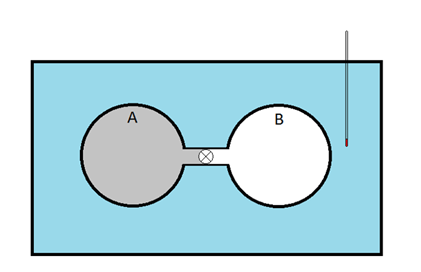
Joule's apparatus consisted of two metal vessels connected by a stopcock. One vessel contained a gas, while the other was evacuated.
Gas-filled vessel → Vacuum
When the stopcock was opened, the gas expanded into the evacuated chamber. The key feature of this experiment is that the gas expands against a vacuum.
Since there is no opposing pressure,
\[ p_{\mathrm{ext}} = 0 \]
and therefore
\[ dw = -p_{\mathrm{ext}}\,dV = 0 \]
Joule had effectively designed an experiment in which the gas could undergo a significant volume change while performing no pressure-volume work.
The First Law of Thermodynamics gives
\[ dU = dq + dw \]
and because
\[ dw = 0 \]
we obtain
\[ dU = dq \]
Joule immersed the apparatus in a water bath so that any heat released or absorbed by the gas would produce a measurable temperature change in the surroundings.
He observed essentially no temperature change and concluded that
\[ dq \approx 0 \]
and therefore
\[ dU \approx 0 \]
Since the gas clearly undergoes a volume change,
\[ dV \neq 0 \]
and Joule believed that
\[ dT = 0 \]
the total differential becomes
\[ dU = \left( \frac{\partial U} {\partial V} \right)_T dV \]
Since he observed
\[ dU \approx 0 \]
and
\[ dV \neq 0 \]
he concluded that
\[ \boxed{ \left( \frac{\partial U} {\partial V} \right)_T = 0 } \]
We now know that Joule's experiment was not sufficiently sensitive to detect the small temperature changes that actually occur in real gases. His result therefore corresponds to the limiting behavior of an ideal gas rather than to all gases.
Big picture: Joule's free-expansion experiment was designed to isolate the internal pressure by eliminating the work term from the First Law. The observation that ideal gases exhibit \(\left(\frac{\partial U}{\partial V}\right)_T=0\) was an important clue that intermolecular interactions are absent in the ideal-gas model.
Evaluate the internal pressure,
\[ \pi_T = \left( \frac{\partial U} {\partial V} \right)_T \]
for a gas that obeys the van der Waals equation of state:
\[ p = \frac{nRT}{V-nb} - \frac{an^2}{V^2} \]
We will use the relationship
\[ \left( \frac{\partial U} {\partial V} \right)_T = T \left( \frac{\partial p} {\partial T} \right)_V - p \]
This relationship will be derived later. For now, we will use it as a thermodynamic tool that allows the internal pressure to be calculated from an equation of state.
First calculate the required partial derivative:
\[ \left( \frac{\partial p} {\partial T} \right)_V = \left( \frac{\partial}{\partial T} \left( \frac{nRT}{V-nb} - \frac{an^2}{V^2} \right) \right)_V \]
\[ \left( \frac{\partial p} {\partial T} \right)_V = \frac{nR}{V-nb} \]
The attractive-force correction, \(-an^2/V^2\), does not contain \(T\), so its temperature derivative is zero.
Substitute this result into the internal-pressure relationship:
\[ \pi_T = T \left( \frac{nR}{V-nb} \right) - p \]
Now substitute the van der Waals equation for \(p\):
\[ \pi_T = \frac{nRT}{V-nb} - \left( \frac{nRT}{V-nb} - \frac{an^2}{V^2} \right) \]
\[ \pi_T = \frac{nRT}{V-nb} - \frac{nRT}{V-nb} + \frac{an^2}{V^2} \]
\[ \boxed{ \pi_T = \frac{an^2}{V^2} } \]
Physical interpretation: For a van der Waals gas, the internal pressure depends only on the attractive-force parameter \(a\), not on the finite-volume parameter \(b\). This makes sense physically: changing the volume at constant temperature changes the average separation between molecules, which changes the intermolecular attraction energy. The stronger the attractions, the larger the internal pressure.
Big picture: The internal pressure describes how the internal energy of a substance changes when its volume changes at constant temperature. Joule's free-expansion experiment showed that this quantity is zero for an ideal gas, while real gases exhibit non-zero internal pressures because of intermolecular interactions.