
The lattice energy of an ionic solid is the enthalpy released when gaseous ions combine to form one mole of crystalline solid:
\[ Na^+(g) + Cl^-(g) \rightarrow NaCl(s) \]
\[ \Delta H \equiv U_{\mathrm{latt}} \]
Because ionic solids are stabilized by strong electrostatic attractions, lattice energies are typically large and negative. The larger the magnitude of the lattice energy, the more stable the ionic crystal.
Lattice energies cannot usually be measured directly. Instead, they are determined indirectly using a thermodynamic cycle known as a Born-Haber cycle.
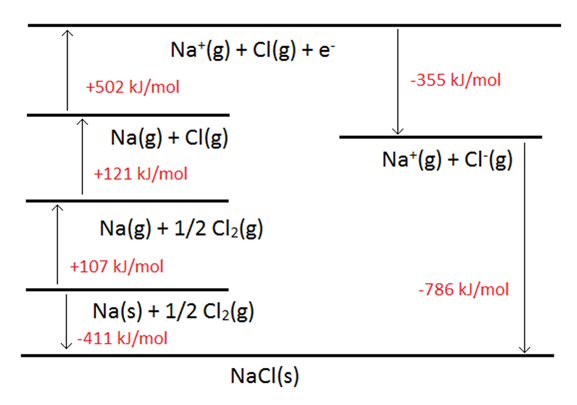
The Born-Haber cycle provides a graphical representation of Hess' Law. Each arrow corresponds to a thermodynamic process with an associated enthalpy change. Because enthalpy is a state function, the sum of the enthalpy changes along any path connecting the same initial and final states must be identical.
Consider the formation of sodium chloride:
\[ Na(s) + \frac{1}{2}Cl_2(g) \rightarrow NaCl(s) \]
Rather than forming the solid directly, imagine carrying out the process in several hypothetical steps:
| Step | Process | Enthalpy |
|---|---|---|
| 1 | \(Na(s)\rightarrow Na(g)\) | \(\Delta H_{sub}\) |
| 2 | \(Na(g)\rightarrow Na^+(g)+e^-\) | \(IP_1\) |
| 3 | \(\frac12 Cl_2(g)\rightarrow Cl(g)\) | \(\frac12 D(Cl-Cl)\) |
| 4 | \(Cl(g)+e^-\rightarrow Cl^-(g)\) | \(-EA\) |
| 5 | \(Na^+(g)+Cl^-(g)\rightarrow NaCl(s)\) | \(U_{latt}\) |
Adding these five reactions produces the overall formation reaction for sodium chloride.
Since enthalpy is a state function, Hess' Law requires that the enthalpies add in exactly the same way:
\[ \Delta H_f^\circ = \Delta H_{sub} + IP_1 + \frac12 D(Cl-Cl) - EA + U_{latt} \]
Rearranging gives an expression for the lattice energy:
\[ U_{latt} = \Delta H_f^\circ - \Delta H_{sub} - IP_1 - \frac12 D(Cl-Cl) + EA \]
Born-Haber cycles combine several thermodynamic quantities introduced earlier in this chapter:
Big picture: A Born-Haber cycle is simply Hess' Law applied to the formation of an ionic solid. The cycle provides a way to determine lattice energies from experimentally measurable thermodynamic quantities and illustrates how ionic bonding contributes to the stability of crystalline solids.
Use the Born-Haber cycle for sodium chloride to calculate the lattice energy for the process
\[ Na^+(g) + Cl^-(g) \rightarrow NaCl(s) \]
The overall formation reaction is
\[ Na(s) + \frac{1}{2}Cl_2(g) \rightarrow NaCl(s) \]
with
\[ \Delta H_f^\circ = -411\ \mathrm{kJ\,mol^{-1}} \]
The Born-Haber cycle breaks this formation reaction into several steps:
| Step | Process | Enthalpy change |
|---|---|---|
| 1. Sublimation of sodium | \(Na(s)\rightarrow Na(g)\) | \(+107\ \mathrm{kJ\,mol^{-1}}\) |
| 2. Dissociation of chlorine | \(\frac{1}{2}Cl_2(g)\rightarrow Cl(g)\) | \(+121\ \mathrm{kJ\,mol^{-1}}\) |
| 3. Ionization of sodium | \(Na(g)\rightarrow Na^+(g)+e^-\) | \(+502\ \mathrm{kJ\,mol^{-1}}\) |
| 4. Electron capture by chlorine | \(Cl(g)+e^-\rightarrow Cl^-(g)\) | \(-355\ \mathrm{kJ\,mol^{-1}}\) |
| 5. Formation of the ionic solid | \(Na^+(g)+Cl^-(g)\rightarrow NaCl(s)\) | \(U_{\mathrm{latt}}\) |
By Hess' Law, the sum of the individual steps must equal the standard enthalpy of formation:
\[ \Delta H_f^\circ = \Delta H_{\mathrm{sub}} + \frac{1}{2}D(Cl{-}Cl) + IP_1(Na) - EA(Cl) + U_{\mathrm{latt}} \]
Substitute the values, keeping units attached to every term:
\[ -411\ \mathrm{kJ\,mol^{-1}} = 107\ \mathrm{kJ\,mol^{-1}} + 121\ \mathrm{kJ\,mol^{-1}} + 502\ \mathrm{kJ\,mol^{-1}} - 355\ \mathrm{kJ\,mol^{-1}} + U_{\mathrm{latt}} \]
Combine the known terms:
\[ -411\ \mathrm{kJ\,mol^{-1}} = 375\ \mathrm{kJ\,mol^{-1}} + U_{\mathrm{latt}} \]
Solve for the lattice energy:
\[ U_{\mathrm{latt}} = -411\ \mathrm{kJ\,mol^{-1}} - 375\ \mathrm{kJ\,mol^{-1}} \]
\[ U_{\mathrm{latt}} = -786\ \mathrm{kJ\,mol^{-1}} \]
Therefore,
\[ \boxed{ U_{\mathrm{latt}} = -786\ \mathrm{kJ\,mol^{-1}} } \]
Physical interpretation: The negative sign indicates that energy is released when gaseous \(Na^+\) and \(Cl^-\) ions combine to form the solid ionic lattice. The large magnitude reflects the strong electrostatic attraction between oppositely charged ions in crystalline sodium chloride.
Big picture: Born-Haber cycles combine many of the thermodynamic concepts developed throughout this chapter—reaction enthalpies, Hess' Law, bond enthalpies, ionization potentials, electron affinities, and lattice energies. By applying Hess' Law to the formation of an ionic solid, lattice energies can be determined even when they cannot be measured directly.