
A Maxwell-Boltzmann distribution is a graph of
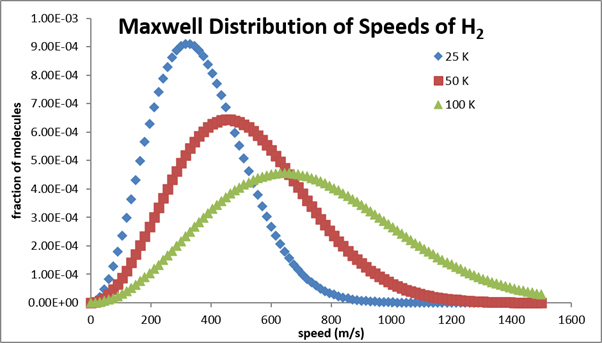
\[ \text{fraction of molecules} \quad \text{vs.} \quad \text{molecular speed} \]
Big picture: A thermalized gas is not characterized by a single molecular speed. Instead, it is characterized by a distribution of molecular speeds whose shape is determined by the temperature and molecular mass of the gas.
Use the controls to explore how temperature and molecular mass affect molecular speeds.
Single-gas mode: all particles have the same molecular mass, and their speeds are chosen from a Maxwell-Boltzmann-like distribution.
For a thermalized sample of gas, the fraction of molecules having speeds between \(v\) and \(v+dv\) is described by the Maxwell-Boltzmann distribution:
\[ f(v) = 4\pi \left( \frac{m}{2\pi k_B T} \right)^{3/2} v^2 \exp \left( -\frac{mv^2}{2k_B T} \right) \]
In this expression, \(m\) is the mass of a single molecule, \(k_B\) is Boltzmann's constant, \(T\) is the absolute temperature, and \(v\) is the molecular speed. The quantity \(f(v)\) represents a probability density, meaning that the area under the curve corresponds to the fraction of molecules in a given range of speeds.
The distribution contains two competing effects. The \(v^2\) term causes the distribution to increase at small values of \(v\), while the exponential term causes the distribution to decrease rapidly at large values of \(v\). The result is the familiar bell-shaped curve observed for thermalized gases.
Increasing the temperature broadens the distribution and shifts it toward higher speeds. Increasing the molecular mass shifts the distribution toward lower speeds because heavier molecules move more slowly than lighter molecules at the same temperature.
Because a gas contains molecules moving at many different speeds, it is useful to define several characteristic speeds that describe different aspects of the distribution.
| Quantity | Expression | Meaning |
|---|---|---|
| Most Probable Speed | \[ v_{mp} = \sqrt{ \frac{2RT}{MW} } \] | The speed corresponding to the peak of the distribution. |
| Average Speed | \[ v_{ave} = \sqrt{ \frac{8RT}{\pi MW} } \] | The arithmetic average of all molecular speeds. |
| Root-Mean-Square Speed | \[ v_{rms} = \sqrt{ \frac{3RT}{MW} } \] | The square root of the average value of \(v^2\). |
Here \(R\) is the ideal gas constant, \(T\) is the absolute temperature, and \(MW\) is the molar mass of the gas.
These characteristic speeds always obey the relationship
\[ v_{mp} < v_{ave} < v_{rms} \]
because the Maxwell-Boltzmann distribution is skewed toward higher speeds. The RMS speed is largest because squaring the velocity gives extra weight to the fastest-moving molecules.
All three characteristic speeds depend on temperature and molecular mass in the same general way:
\[ v \propto \sqrt{\frac{T}{MW}} \]
Big picture: The Maxwell-Boltzmann distribution provides a statistical description of molecular motion. Rather than assigning a single speed to every molecule, it predicts the distribution of molecular speeds and allows us to calculate useful quantities such as the most probable, average, and RMS speeds.
Calculate the average molecular speed of nitrogen gas, N2, at \(298\ \mathrm{K}\) and \(1.00\ \mathrm{atm}\).
The average molecular speed is given by
\[ v_{ave} = \left( \frac{8RT}{\pi MW} \right)^{1/2} \]
The quantities needed are
\[ R = 8.314\ \mathrm{J\,mol^{-1}\,K^{-1}} \]
\[ T = 298\ \mathrm{K} \]
\[ MW = 0.028014\ \mathrm{kg\,mol^{-1}} \]
Substituting these values into the equation gives
\[ v_{ave} = \left( \frac{ 8 \left( 8.314\ \mathrm{J\,mol^{-1}\,K^{-1}} \right) \left( 298\ \mathrm{K} \right) } { \pi \left( 0.028014\ \mathrm{kg\,mol^{-1}} \right) } \right)^{1/2} \]
\[ v_{ave} = \left( 2.25\times10^{5}\ \mathrm{m^2\,s^{-2}} \right)^{1/2} \]
\[ v_{ave} = 474\ \mathrm{m\,s^{-1}} \]
Therefore, the average molecular speed of N2 at \(298\ \mathrm{K}\) is
\[ v_{ave} = 474\ \mathrm{m\,s^{-1}} \]
Note: Although the pressure of the gas was provided in the problem statement, it was not needed for the calculation. The characteristic speeds of a thermalized gas depend only on the temperature and molecular mass. Increasing the pressure changes how closely the molecules are packed together, but it does not change the form of the Maxwell-Boltzmann distribution or the average molecular speed.
Helium has a normal boiling point of approximately \(4\ \mathrm{K}\). Calculate the root-mean-square (RMS) speed of helium atoms at this temperature.
The RMS speed is given by
\[ v_{rms} = \left( \frac{3RT}{MW} \right)^{1/2} \]
The quantities needed are
\[ R = 8.314\ \mathrm{J\,mol^{-1}\,K^{-1}} \]
\[ T = 4.00\ \mathrm{K} \]
\[ MW = 0.004003\ \mathrm{kg\,mol^{-1}} \]
Substituting these values into the RMS speed equation gives
\[ v_{rms} = \left( \frac{ 3 \left( 8.314\ \mathrm{J\,mol^{-1}\,K^{-1}} \right) \left( 4.00\ \mathrm{K} \right) } { 0.004003\ \mathrm{kg\,mol^{-1}} } \right)^{1/2} \]
\[ v_{rms} = \left( 2.49\times10^{4}\ \mathrm{m^2\,s^{-2}} \right)^{1/2} \]
\[ v_{rms} = 158\ \mathrm{m\,s^{-1}} \]
Therefore, the RMS speed of helium atoms at \(4\ \mathrm{K}\) is
\[ v_{rms} = 158\ \mathrm{m\,s^{-1}} \]
Physical interpretation: Even at a temperature only a few degrees above absolute zero, helium atoms are still moving surprisingly rapidly. This occurs because helium has a very small molar mass. The RMS speed depends on the ratio \(T/MW\), so light gases can possess substantial molecular speeds even at very low temperatures.
Comparison: At room temperature (\(298\ \mathrm{K}\)), helium atoms have an RMS speed of approximately \(1360\ \mathrm{m\,s^{-1}}\), nearly nine times faster than at \(4\ \mathrm{K}\). The speed does not decrease in direct proportion to temperature because molecular speeds are proportional to \(\sqrt{T}\), not \(T\) itself.
First choose the correct formula. Then choose the correct numerical answer.
| Select the Correct Formula | |
|---|---|
| \[v = \left( \frac{2RT}{MW} \right)^{1/2} \] | |
| \[ v = \left( \frac{8RT}{\pi MW} \right)^{1/2} \] | |
| \[ v = \left( \frac{3RT}{MW} \right)^{1/2} \] | |
| \[ R = 8.314 \frac{J}{mol K} \] | |
Big picture: A gas is not characterized by a single molecular speed, but by a distribution of speeds. The Maxwell-Boltzmann distribution provides a statistical description of molecular motion and explains how temperature and molecular mass determine the behavior of thermalized gas samples.