
The rigid rotor describes the rotational motion of a molecule in three dimensions. Because this motion naturally involves angles rather than linear displacements, it is most conveniently described using spherical polar coordinates.
1. Definition of spherical polar coordinates
In spherical polar coordinates, the position of a point in space is specified by three variables:
- \(r\) — the distance from the origin to the point,
- \(\theta\) — the polar angle, measured from the positive \(z\)-axis (\(0 \le \theta \le \pi\)),
- \(\phi\) — the azimuthal angle, measured in the \(xy\)-plane from the positive \(x\)-axis (\(0 \le \phi < 2\pi\)).
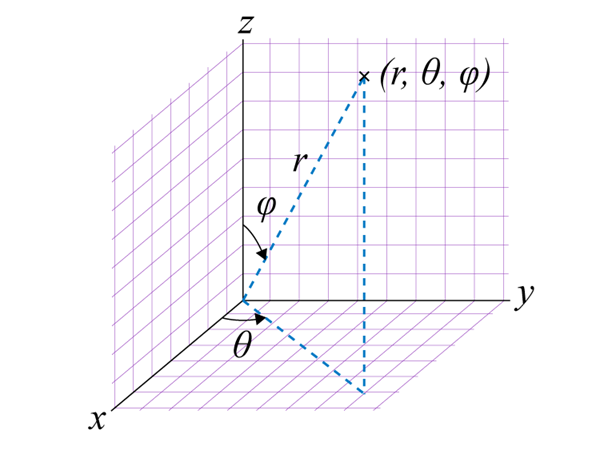
The coordinate \(r\) gives the size of the position vector, while \( \theta \) and \( \phi \) specify its orientation in space.
For the rigid rotor, the bond length is fixed, so \(r\) is constant and the motion is entirely angular.
2. Conversion between Cartesian and spherical coordinates
The relationship between Cartesian coordinates \((x,y,z)\) and spherical polar coordinates \((r,\theta,\phi)\) is given by the following expressions.
From spherical to Cartesian
\[ \begin{aligned} x &= r\sin\theta\cos\phi, \\ y &= r\sin\theta\sin\phi, \\ z &= r\cos\theta. \end{aligned} \]
From Cartesian to spherical
\[ \begin{aligned} r &= \sqrt{x^2+y^2+z^2}, \\ \theta &= \cos^{-1}\!\left(\frac{z}{r}\right), \\ \phi &= \tan^{-1}\!\left(\frac{y}{x}\right). \end{aligned} \]
These transformations allow problems involving rotational motion to be expressed naturally in terms of angles rather than linear coordinates.
The Laplacian in spherical polar coordinates
In quantum mechanics, the kinetic energy operator involves the Laplacian, \(\nabla^2\). In Cartesian coordinates, the Laplacian has the familiar form
\[ \nabla^2 = \frac{\partial^2}{\partial x^2} + \frac{\partial^2}{\partial y^2} + \frac{\partial^2}{\partial z^2}. \]
For problems involving rotational motion, this form is inconvenient. Expressing the Laplacian in spherical polar coordinates \((r,\theta,\phi)\) allows radial and angular motion to be treated separately.
Transformation to spherical coordinates
After applying the chain rule to the Cartesian derivatives and regrouping terms, the Laplacian becomes
\[ \nabla^2 = \frac{1}{r^2}\frac{\partial}{\partial r} \left( r^2\frac{\partial}{\partial r} \right) + \frac{1}{r^2\sin\theta}\frac{\partial}{\partial\theta} \left( \sin\theta\,\frac{\partial}{\partial\theta} \right) + \frac{1}{r^2\sin^2\theta}\frac{\partial^2}{\partial\phi^2}. \]
The first term involves only derivatives with respect to \(r\) and describes radial motion. The remaining terms involve derivatives with respect to \( \theta \) and \( \phi \) and describe angular motion.
Specialization to the rigid rotor
In the rigid rotor model, the bond length is fixed, so \(r\) is constant. As a result, the radial derivatives vanish, and only the angular part of the Laplacian contributes to the kinetic energy.
The angular part of the Laplacian is therefore
\[ \nabla^2_{\text{angular}} = \frac{1}{\sin\theta}\frac{\partial}{\partial\theta} \left( \sin\theta\,\frac{\partial}{\partial\theta} \right) + \frac{1}{\sin^2\theta}\frac{\partial^2}{\partial\phi^2}. \]
This operator governs the rotational motion of the molecule and leads directly to the rigid rotor Schrödinger equation and quantized rotational energy levels.
Big idea: rewriting the Laplacian in spherical polar coordinates isolates the angular motion responsible for molecular rotation, making the rigid rotor problem mathematically tractable.
Big idea: spherical polar coordinates separate radial and angular motion, making them the natural coordinate system for describing molecular rotation and setting the stage for the rigid rotor Schrödinger equation.