
CSU East Bay logo

Chemistry 352

The Free Electron Model

The Free Electron Model

an application of the Particle in a Box Problem

Worked Example: 1,3-Butadiene (Kuhn Free Electron Model)

We will use Kuhn’s free electron model to estimate the HOMO–LUMO gap and the absorption wavelength for 1,3-butadiene (\( \mathrm{C_4H_6} \)). The key steps are: (1) estimate the box length \(L\), (2) count \( \pi \) electrons, (3) fill energy levels, (4) compute the HOMO–LUMO energy gap, and (5) convert to a wavelength.


Step 1: Estimate the box length, \(L\)

Butadiene has 4 conjugated carbon atoms, so its conjugated backbone contains \(N=4\) carbons. A simple (common) approximation is: take an average C–C spacing of about \(1.40~\text{Å}\) (which is roughly the C-C distance in benzene), and add “half a bond” at each end. This makes the box length approximately

\[ L \approx N(1.40~\text{Å}) = 4(1.40~\text{Å}) = 5.6~\text{Å} = 5.6\times 10^{-10}~\text{m}. \]

(This end-correction is a simple way to reflect that the electron density does not abruptly stop exactly at the terminal carbons.)


Step 2: Count the \( \pi \) electrons

Each carbon atom in the cunjugated backbone contributes one \( \pi \) electron, so butadiene has

\[ N_{\pi} = 4~\pi\text{ electrons}. \]


Step 3: Fill the particle-in-a-box levels

The particle-in-a-box energies are

\[ E_n = \frac{n^2h^2}{8mL^2}, \qquad n=1,2,3,\dots \]

Each energy level holds 2 electrons (with paired spins). With 4 electrons:

So for butadiene: \(n_{\text{HOMO}}=2\) and \(n_{\text{LUMO}}=3\).


Step 4: Compute the HOMO–LUMO energy gap

The predicted gap is \( \Delta E = E_{3}-E_{2} \):

\[ \Delta E = \frac{h^2}{8mL^2}\left(3^2-2^2\right) = \frac{5h^2}{8mL^2}. \]

Using \(h=6.626\times10^{-34}~\text{J·s}\), \(m=m_e=9.11\times10^{-31}~\text{kg}\), and \(L=5.6\times10^{-10}~\text{m}\):

\[ \Delta E \approx 9.61\times10^{-19}~\text{J} \approx 6.00~\text{eV}. \]


Step 5: Predict the absorption wavelength

Approximate the electronic transition energy as the photon energy: \( \Delta E \approx \frac{hc}{\lambda} \). Therefore

\[ \lambda \approx \frac{hc}{\Delta E}. \]

With \(c=3.00\times10^8~\text{m/s}\) and the \( \Delta E \) above:

\[ \lambda \approx 2.07\times10^{-7}~\text{m} = 207~\text{nm}. \]

Prediction: butadiene should absorb in the UV (around \( \sim 200~\text{nm} \)), and longer polyenes (larger \(L\)) will shift to longer wavelengths.

Here is an image showing the UV/VIS absorption spectrum of 1,3-butadiene.
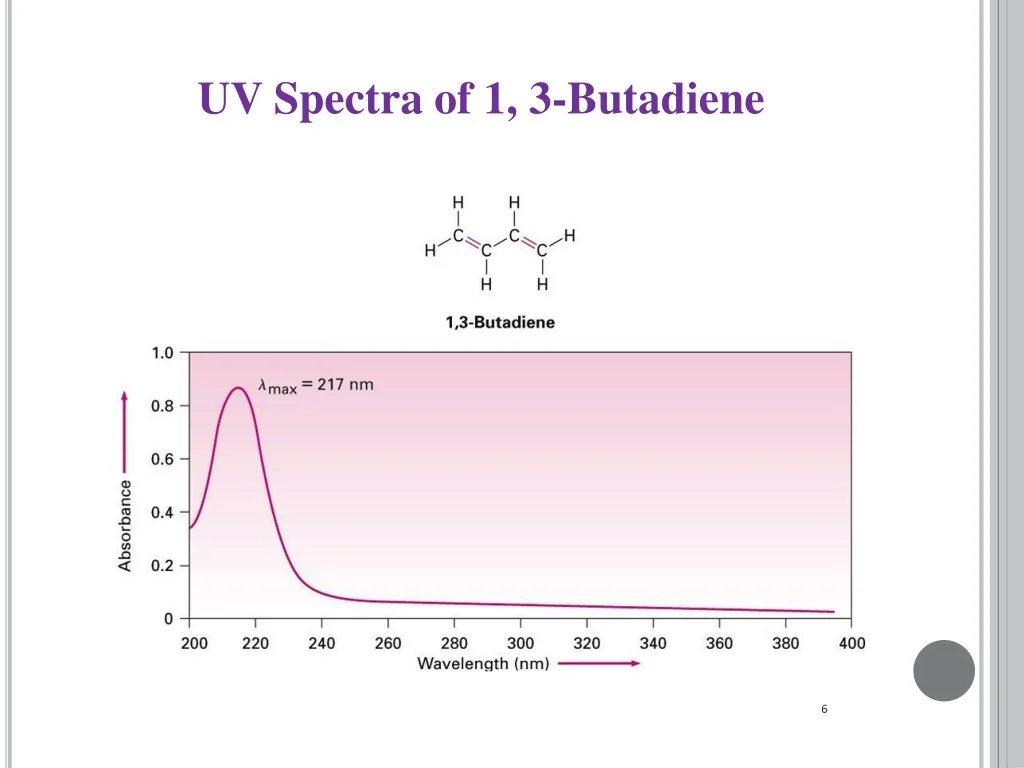
UV/VIS absorption spectrum of 1,3-butadiene showing λ<sub>max</sub> at 217 nm.

Now it's your turn!

Example 1
Using the Kuhn free-electron (particle-in-a-box) model and the same length estimate used in the worked example (\(L \approx N(1.40~\text{Å})\) where \(N\) is the number of conjugated carbon atoms), what is the approximate box length \(L\) for 1,3,5-hexatriene (\(N=6\))?
\( 4.2~\text{Å} \) \( 5.6~\text{Å} \) \( 7.0~\text{Å} \) \( 8.4~\text{Å} \) \( 14.0~\text{Å} \)
Example 2
1,3,5-hexatriene has \(6\) conjugated carbon atoms and therefore \(6\) \( \pi \) electrons. Each particle-in-a-box level holds two electrons. Which pair of quantum numbers corresponds to the HOMO and LUMO?
\( n_{\text{HOMO}}=2,\; n_{\text{LUMO}}=3 \) \( n_{\text{HOMO}}=3,\; n_{\text{LUMO}}=4 \) \( n_{\text{HOMO}}=4,\; n_{\text{LUMO}}=5 \) \( n_{\text{HOMO}}=1,\; n_{\text{LUMO}}=2 \) \( n_{\text{HOMO}}=3,\; n_{\text{LUMO}}=5 \)
Example 3
For 1,3,5-hexatriene you found (or were told) that \(n_{\text{HOMO}}=3\) and \(n_{\text{LUMO}}=4\). Using \(E_n=\frac{n^2h^2}{8mL^2}\), which expression equals the HOMO–LUMO energy gap \(\Delta E = E_{\text{LUMO}}-E_{\text{HOMO}}\)?
\( \Delta E=\frac{h^2}{8mL^2}(4^2-3^2) \) \( \Delta E=\frac{h^2}{8mL^2}(4-3) \) \( \Delta E=\frac{h^2}{8mL^2}(3^2-4^2) \) \( \Delta E=\frac{h^2}{8mL^2}(4^2+3^2) \) \( \Delta E=\frac{h^2}{8mL^2}(2^2-1^2) \)
Example 4
Using your result for the box length \( L = 8.4\times10^{-10}\,\text{m} \) for 1,3,5-hexatriene and \( n_{\text{HOMO}}=3 \), \( n_{\text{LUMO}}=4 \), calculate the HOMO–LUMO energy gap in joules.
\( h=6.626\times10^{-34}\,\text{J·s},\; m_e=9.11\times10^{-31}\,\text{kg} \)
\( 6.0\times10^{-19}\,\text{J} \) \( 6.0\times10^{-20}\,\text{J} \) \( 3.0\times10^{-18}\,\text{J} \) \( 9.6\times10^{-19}\,\text{J} \) \( 1.1\times10^{-19}\,\text{J} \)
Example 5
Using your calculated HOMO–LUMO energy gap \( \Delta E = 6.0\times10^{-19}\,\text{J} \), estimate the absorption wavelength \( \lambda_{\max} \) for 1,3,5-hexatriene.
\( \lambda = \frac{hc}{\Delta E}, \quad h=6.626\times10^{-34}\,\text{J·s}, \; c=3.00\times10^8\,\text{m/s} \)
\( 120~\text{nm} \) \( 210~\text{nm} \) \( 330~\text{nm} \) \( 480~\text{nm} \) \( 750~\text{nm} \)

Let's compare to experiment!

The free-electron (particle-in-a-box) model predicts an absorption wavelength of approximately \( \lambda_{\max} \approx 330~\text{nm} \) for 1,3,5-hexatriene. Experimentally, however, the strongest \( \pi \rightarrow \pi^* \) absorption occurs at \( \lambda_{\max} = 258~\text{nm} \). This discrepancy highlights the approximate nature of the model.

We can use the experimental wavelength to determine an effective box length by working backward from the observed transition energy. First, convert the wavelength into an energy gap using

\[ \Delta E = \frac{hc}{\lambda}. \]

For \( \lambda = 258~\text{nm} \) (\(2.58\times10^{-7}~\text{m}\)):

\[ \Delta E = \frac{(6.626\times10^{-34}\,\text{J·s})(3.00\times10^{8}\,\text{m/s})} {2.58\times10^{-7}\,\text{m}} \approx 7.7\times10^{-19}~\text{J}. \]

For 1,3,5-hexatriene, the HOMO–LUMO transition corresponds to \( n=3 \rightarrow n=4 \), so the particle-in-a-box energy gap is

\[ \Delta E = \frac{h^2}{8mL^2}(4^2-3^2) = \frac{7h^2}{8mL^2}. \]

Solving for the box length \(L\) gives

\[ L = \sqrt{\frac{7h^2}{8m\Delta E}} \approx 7.5\times10^{-10}~\text{m} = 7.5~\text{Å}. \]

This effective box length is shorter than the simple structural estimate (\(L \approx 8.4~\text{Å}\)). The higher experimental transition energy therefore implies that the \( \pi \) electrons are more confined than predicted by the idealized model.

Physically, this reflects several limitations of the free-electron model: real molecules are not perfectly one-dimensional, the potential confining the electrons is not infinite, and electron–nuclear interactions are neglected. As a result, the particle-in-a-box length should be viewed as an effective parameter, not a literal molecular dimension.

Big idea: comparing predicted and experimental absorption wavelengths allows the free-electron model to be calibrated and reveals where simple quantum models succeed—and where they break down.

Key points (one glance)